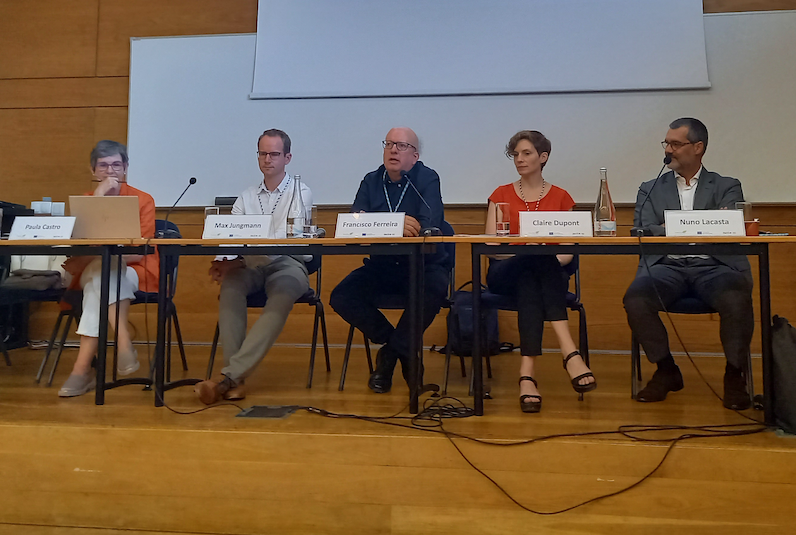

The panel debate focused on the challenges and opportunities in implementing European environmental policies, including the contestation of nature restoration and biodiversity policies, the need for local involvement and trust-building, and the shift towards a philosophical understanding of the nature-people relationship.
The speakers emphasized the role of different actors, such as the private sector, local governments, and NGOs, in driving sustainability measures. They discussed the importance of transparency, accountability, and sustainable finance, as well as the challenges of infrastructure gaps, air pollution, and corporate responsibility. The panel also raised questions about the coherence and ambition of European policies, the concept of a just transition, and the potential for sustainable development in areas such as awareness building, supply chains, and finance.
Overall, the debate highlighted the complexities and opportunities in implementing European environmental policies, with a focus on local involvement, transformative changes, and the need for further research to understand contestation dynamics.
Watch all recordings from the GreenDeal-NET conference
Panel
Nuno Lacasta has been working on environment and sustainable development for over 20 years in Europe and in the United States. Since 2012 he has been serving as CEO of APA. He has been in public service since 2003, having led the Portuguese Environment Ministry’s International Department, coordinated Portugal’s climate policy and directed the Portuguese Carbon Fund. In his capacity at APA, he served as Bureau member of the European Environment Agency (EEA), and as OECD Environmental Policy Committee’s Chair.
Claire Dupont is Research Professor of European governance of sustainability transformations at Ghent University. Her research focuses on the policy, politics and governance of the climate neutrality and sustainability transitions in Europe. She is chair of the Scientific Committee of the European Environment Agency (EEA) and member of the Climate Policy Observatory of Luxembourg.
Max Jungmann is the Executive Manager of the Heidelberg Center for the Environment (HCE) at Heidelberg University and the CEO of Momentum Novum, a strategy consultancy for sustainable development. He holds a PhD in Political Science and teaches at Heidelberg University, the Karlsruhe Institute of Technology (KIT), the Steinbeis Business Academy (SBA), the Steinbeis School of International Business and Entrepreneurship (SIBE), and the German Federal Foreign Office.
Francisco Ferreira is currently president of "ZERO - Sustainable Terrestrial System Association", a non-governmental environment organisation with national activity. He is also a professor at NOVA School of Science and Technology (NOVA FCT) and a researcher at the Centre for Environmental and Sustainability Research (CENSE). He was president of Quercus from 1996 to 2001 and vice-president from 2007 to 2011. He was a member of the National Water Council and the National Council for Environment and Sustainable Development.
Moderator
Paula Castro is Full Professor of Psychology at Iscte and a researcher at CIS-Iscte. Her research looks at the processes of meaning-making and communication involved in the reception of new laws and public policies - mainly environmental ones - developing a social psychology of legal innovation. She has mainly investigated how new laws and policies governing climate action, biodiversity conservation, public participation or urban transformation are received by the public and the implications of this reception for social and personal change. The studies, both quantitative and qualitative, often focus on (the asymmetric) relations between public and scientific experts/decision makers. Other areas of interest are peoples' relations to place, local knowledge, and social memory.