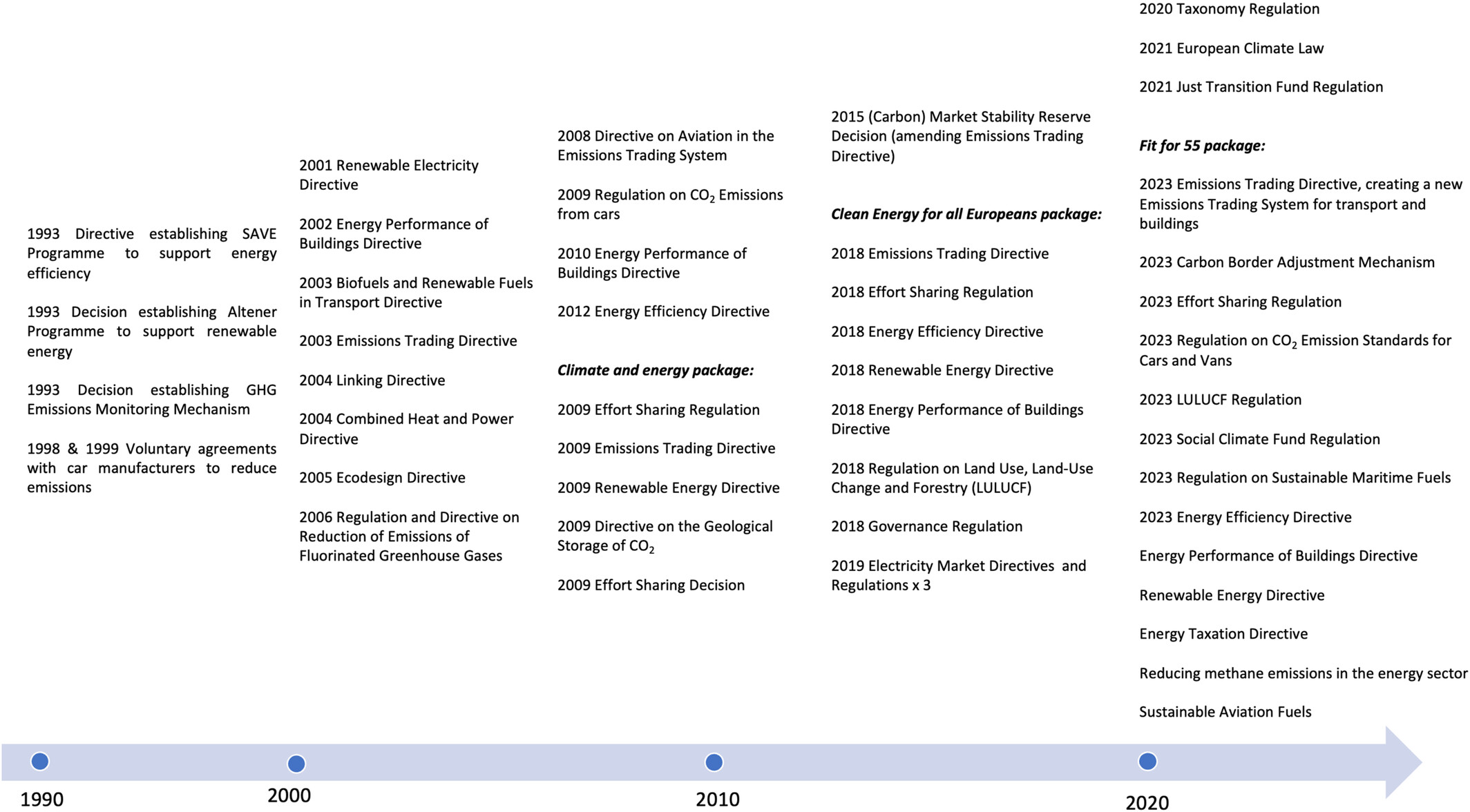
The Evolution of EU Climate and Energy Policy from 1990 to 2020
Since the 1990s, the EU has continuously passed climate legislation and developed the building blocks for today's policy instruments. To help you understand what has driven EU climate efforts, this module gives you a comprehensive overview of the EU's climate policy development from the 1990s until 2020.
It starts with a 25-minute video that details the evolution of climate and energy governance in the EU. To test your understanding of the video, it will be followed by a quiz and a reflection exercise.
Module outline
- Video lecture: The Evolution of EU Climate and Energy Policy over the last 30 years.
- A quiz based on the article.
- A reflection exercise on the video.
- Further reading/resources
- Answer key of the quiz
Concepts relevant to Module 1:
Adaptation, Anthropocene, Burden Sharing, Climate Law, Climate Neutrality, Conference of the Parties (COP), Decarbonisation, Decoupling, Degrowth, Energy Union, EU ETS, European Green Deal (EGD), Green growth, Just Transition, Kyoto Protocol, Low Carbon Society, LULUCF, Mitigation, National Energy and Climate Plans (NECPs), Negative Emissions, Sustainable Development, UNFCCC, 2020 Climate and Energy Package, 2030 Framework.
The Evolution of EU Climate and Energy Policy over the last 30 years
Over the last three decades, the European Union has sought to play a leadership role in the international climate debate by formulating ambitious and comprehensive domestic climate policies. Since the early 1990s, the EU has developed and implemented a sophisticated legal and policy framework with the aim of limiting global warming by reducing greenhouse gas emissions and by incentivising the uptake of renewable energy as well as energy efficiency.
Policy development has been driven by a diversity of concerns:
to prevent distortions of the EU’s internal market by minimising national differences in policy; to amplify the domestic legitimacy of European integration; to strengthen European energy security; and to increase economic competitiveness. Furthermore, the EU has been an active actor at the global level, and, in turn, the global level has significantly shaped EU policy development.
The development of the EU’s climate policy framework can offer useful lessons for climate governance in other parts of the world. For example, as a supranational organisation of 27 Member States, the EU provides insights for other jurisdictions on how a group of socially and economically diverse countries can potentially cooperate to mitigate climate change. In addition, the EU’s governance structures and alignment with international climate change treaties can offer relevant lessons.
There exists, however, ample room for improvement and gaps can be identified, mainly in relation to issues of comprehensiveness, level of impact, slowness in implementation and governance. The EU’s climate policy framework may have adopted criteria of internal fairness and equity for allocating responsibilities between the Member States and compensating those with fewer resources or critically affected interests, yet its mitigation ambition is not based on any explicit criteria for global fairness and equity, and the bloc’s ambition is arguably not in line with the 1.5/2°C temperature goal included in the Paris Agreement.
Video Lecture for Module 1: Evolution of EU climate policy
(We recommend you watch this in full screen)
This video lecture is largely based on ‘Three decades of learning-by-doing: The evolving climate change mitigation policy of the European Union’., by Kati Kulovesi and Harro van Asselt.
With added text from ‘Climate Change Policy in the European Union.‘ by Tim Rayner and Andrew Jordan.
Quiz
This quiz is based on the video you just watched. There is only one correct response per question. Write down the answer you think is correct. The results can be found at the bottom of this webpage.
1. What was the first international climate agreement?
- A) Kyoto Protocol
- B) Rio de Janeiro Agreement
- C) Copenhagen Accord
- D) Brussels Treaty
- E) The Paris Agreement
2. What were the headline targets of the 2020 Package?
- A) 30% greenhouse gas reduction, 30% share in renewable energy, 30% improvement in energy efficiency
- B) 20% greenhouse gas reduction, 20% share in renewable energy, 20% improvement in energy efficiency
- C) 30% greenhouse gas reduction, 30% share in renewable energy, 30% reduction in energy efficiency
- D) 20% greenhouse gas reduction, 20% share in renewable energy, 20% reduction in energy efficiency
3. Which new element was added (not revised) to the 2030 Framework?
- A) Effort Sharing Regulation
- B) ETS Directive
- C) LULUCF Regulation
- D) Renewable Energy Directive
4. What is the long-term objective of the European Green Deal?
- A) Climate neutrality by 2030
- B) Climate neutrality by 2055
- C) Climate neutrality by 2070
- D) Climate neutrality by 2050
5. Which of these statements is not correct?
- A) The EU has followed a strategy of learning by doing
- B) EU climate policies interact closely with international climate cooperation
- C) The diversity among EU Member States and a decision-making process that aims for consensus has affected the ambitiousness of EU climate policy and the concrete design of instruments
- D) The Effort Sharing Regulation is undeniably the EU’s flagship policy instrument, covering 45 % of the Union’s greenhouse gas emissions
Module 1 Reflections
Take some time to reflect on the video.
- What surprised you/struck you while you watched the video? Did the video change/clarify your opinion on any particular part of the EU policy developments?
- What do you see as the main drivers and greatest opportunities for climate action? What do you think are the main barriers to a just transition to a low carbon society?
Further reading
State of the art review on Three decades of EU climate policy: Racing toward climate neutrality?
Complete overview