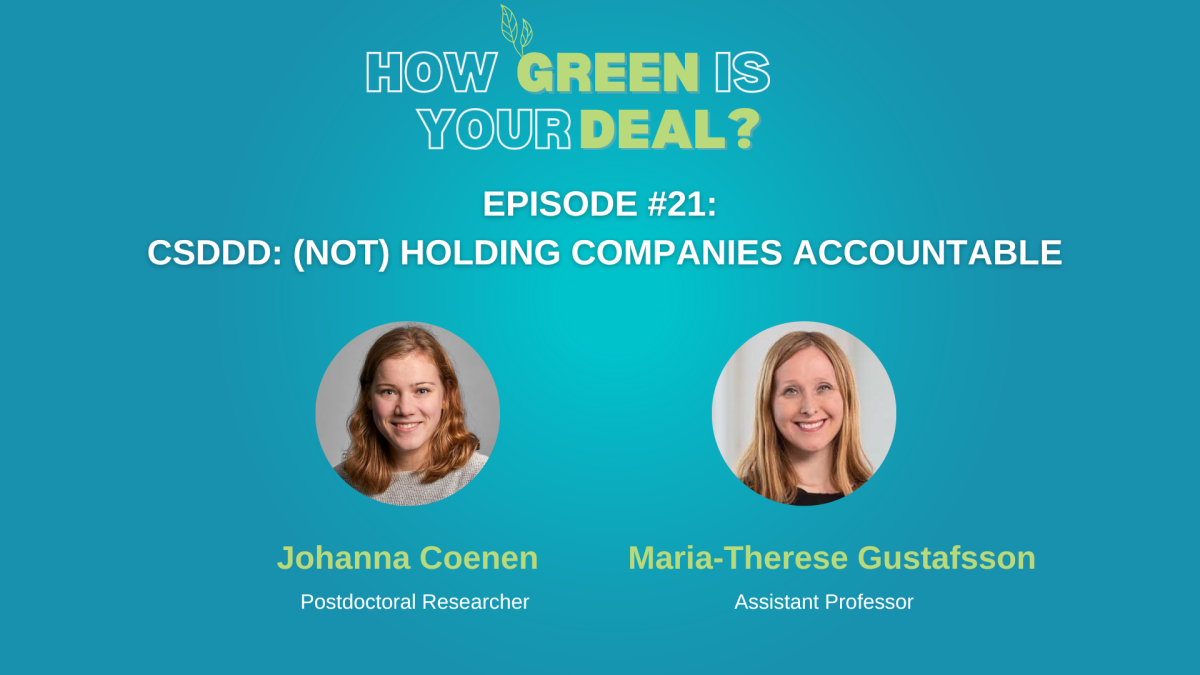
Episode #21: CSDDD
(not) holding companies accountable
The EU imports large amounts of products from the Global South each year. Unfortunately, their production is often associated with child labor, human rights violations, and ecological damage. To combat these issues and to hold companies accountable for the products they sell, the EU has introduced the Corporate Sustainability Directive or CSDDD. However, the CSDDD has found itself in the crosshairs of ongoing turbulence within and outside of the EU.
To help us understand the CSDDD’ objectives, its potential impacts on companies and local stakeholders, and how it has been affected by turbulence, Maria-Therese Gustaffson and Johanna Coenen join us for this episode.
Stay on top of their latest work on the topic by following their ‘Corporate accountability in global supply chains?’ research project.
About the guests
 Johanna Coenen is a postdoctoral researcher at the Department of Political Science at Stockholm University. Her current research focuses on the effectiveness of human rights and environmental due diligence regulations, examining both public and private sustainability governance of global supply chains and their interplay. Johanna holds a doctoral degree in Political Science from Leuphana University (2023), where she studied environmental governance in telecoupled systems, particularly in the context of China’s Belt and Road Initiative and global agri-food trade.
 Maria-Therese Gustafsson is Associate Professor at the Department of Political Science at Stockholm University. Prominent themes in her research are new supply chain regulations, corporate accountability, public and private governance in agricultural and mineral supply chains, with a specific focus on the impacts of global policies at the at the national and local scale. Her research primarily relies on qualitative and ethnographic research methods, and she has lived and carried out extensive fieldwork in rural areas of Latin America, specifically Peru and Brazil.
She has published articles in Environmental Politics, Global Environmental Politics, Regulation and Governance, and World Development, and the monography Private Politics and Peasant Mobilization: Mining in Peru (Palgrave). Maria-Therese Gustafsson is co-directing a research project on “Corporate Accountability in Global Supply Chains? The Effectiveness of Human Rights and Environmental Due Diligence Regulations”, funded by the Swedish Wallenberg Foundation.
Listen to the podcast on
|
|
 |


About the podcast series
 The von der Leyen I Commission set out to put the EU on a pathway toward a sustainable, low-carbon future with the launch of the European Green Deal. However, the Green Deal quickly found itself in rough waters as the COVID-19 pandemic and Russia's invasion of Ukraine risked derailing it all.
To help you understand what the EU aimed at doing in the European Green Deal, how it is impacted by changing times, and what we can expect from the second von der Leyen Commission, GreenDeal-NET created a How Green Deal? In 20- to 30-minute episodes, host and researcher Jana Gheuens talks with leading climate experts about their views on the EU's climate transition. Topics include everything from carbon pricing, the role of climate activism and NGOs, to how to integrate climate action in all the EU’s policy measures.
If you like the podcast, please leave us a review wherever you listen.
Click here to see the full series