
Speed vs. Legitimacy in EU Policymaking:
A False Choice
Following the EU leaders' retreat at the picturesque Alden Biesen Castle, Commission President von der Leyen outlined sweeping reforms to be delivered by 2027. The narrative is clear: EU policymakers need to act fast or the EU risks falling behind. Under this pressure, democratic safeguards are increasingly treated as obstacles rather than essentials. This misses the point: good governance is not an onerous liability but ensures high-quality policy decisions and maintains public trust. The Commission’s ongoing review of the Better Regulation Guidelines is the chance to prove that speed and democratic legitimacy are compatible, not competing objectives.
The speed vs legitimacy fallacy
In recent EU policymaking, established governance practices have increasingly been sidelined in the name of “urgency” and simplification. Since 2024, requirements to conduct impact assessments and stakeholder consultations when preparing legislation, enshrined in the Commission’s Better Regulation framework, have been disregarded across 10 “omnibus” proposals, with further ones announced. Accordingly, in November 2025, the European Ombudsman found that the Commission had bypassed its own Better Regulation Guidelines when revising major sustainability legislation.
Normalising this practice is dangerous. High-quality policy and democratic trust depend on respecting and “living” core governance principles, such as accountability, transparency and public participation. If the Commission treats democratic governance as dispensable whenever urgency calls for speed, upcoming reforms meant to strengthen the European project could deepen its democratic deficit. At a moment when the EU needs maximum legitimacy to carry European societies through far-reaching reforms, it risks alienating citizens through exclusion.
But playing speed against legitimacy is misleading: they are not opposing objectives. Procedural efficiency can go hand in hand with strong democratic governance. The ongoing review of the Commission’s Better Regulation Guidelines offers an opportunity to ensuring this complementarity, while preventing “urgency” from being instrumentalised as a pretext to circumvent foundational elements of good governance.
Reconciling efficient policymaking and democratic legitimacy
We suggest two concrete actions the Commission can undertake to safeguard and develop good democratic governance in the context of the review of the Better Regulation framework.
First, it should transform the scattered public participation landscape into a coherent system, with clear quality standards. Currently, mechanisms range from public consultations to citizens' panels to strategic dialogues, creating fragmentation that produces opacity rather than engagement. It undermines meaningful participation and risks "participation washing", i.e., symbolic public engagement to legitimise rather than genuinely inform decisions. The resulting confusion drives the "stakeholder fatigue" the Commission itself has identified.
To enhance clarity, the Commission could provide an inventory of existing participation mechanisms. Further onwards, this inventory could provide the basis for establishing a digital platform to enhance access to these participation mechanisms.
Importantly, the Commission should also define minimum quality standards applicable across all participation mechanisms. Firmly established in international law and supported by academic research, four key elements concern: (a) inclusiveness and accessibility by ensuring balanced stakeholder representation; (b) transparency by making all relevant information comprehensively publicly available; (c) deliberation by fostering genuine dialogue; and (d) accountability through explaining how participation outcomes have been used.
Second, the Commission should define the scope and mandatory minimum standards of expedited procedures applicable under specific circumstances. The scope of such expedited procedures should be clearly limited to targeted revisions of existing technical legislation and non-legislative initiatives. In case of unforeseen, exigent circumstances, expedited procedures could also be applied to other policy proposals. However, such “exigent” circumstances should be pre-defined (e.g., war, major natural disasters, major financial crises) and invoking them should require explicit and public justification, enabling review and accountability.
Even under expedited timelines, minimum standards of good governance must apply. These should include simplified impact assessments examining key trade-offs, streamlined calls for evidence of minimum 10 days with advance notice, and targeted stakeholder consultations ensuring transparent, balanced participation. Safeguarding such minimum standards is not a procedural luxury but essential for preserving the double-benefits of good governance also under expedited procedures: legitimacy and effective policymaking that supports successful implementation.
These reforms reinforce each other. A functional participation system makes expedited procedures feasible because stakeholders know how to engage quickly. Clear criteria for acceleration protect the participation system from routine circumvention.
The European project is at a crucial crossroads. Deciding on its future path is too important to use procedural shortcuts that breed cynicism and resistance. The Commission must demonstrate with its revision of the Better Regulation framework that properly designed procedures can reconcile speed and democratic legitimacy. Without appropriate safeguards, acceleration risks becoming not the solution to Europe's challenges, but another source of its democratic malaise.
About the Authors

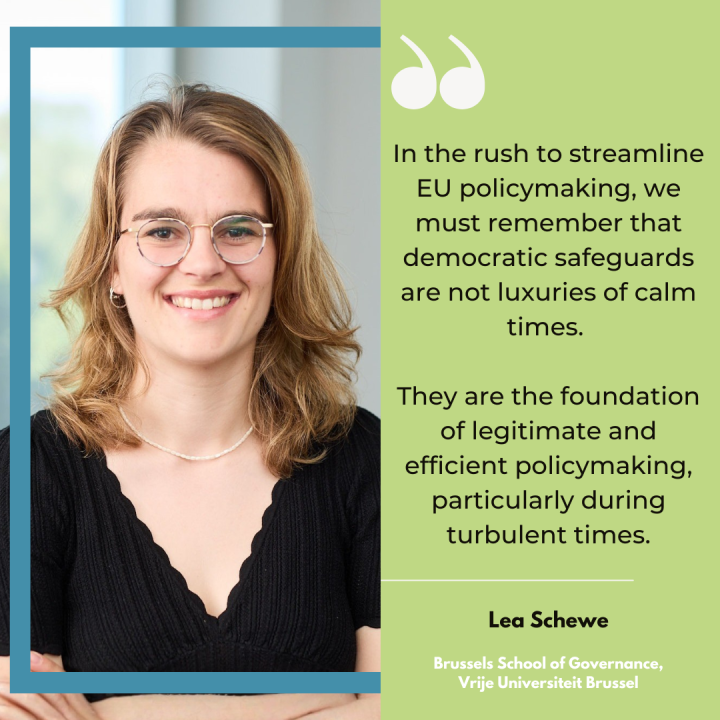
Lea Schewe is a PhD Researcher in the Centre for Environment, Economy and Energy (C3E) of the Brussels School of Governance (BSoG), part of the Vrije Universiteit Brussels (VUB). Her PhD is funded by the research programme on Enhancing Democratic Governance in Europe (EDGE). Lea’s research focuses on topics at the intersection of democratic and climate governance, with a specific focus on public participation in EU-level policies. Her PhD explores the conditions driving and/or hindering high-quality public participation in European climate policy, through the case study of the National Energy and Climate Plans (NECPs). She worked previously as an Associate at the European Climate Foundation (ECF) and as a research associate at the University of Guadeloupe. Lea holds a master’s degree in political Ecology from Sciences Po Lille and a master’s degree in European studies from the BSoG/VUB.

Simon Otto is a researcher in the Centre for Environment, Economy and Energy at the Brussels School of Governance. As part of the NDC ASPECTS project, his research focuses on advancing international climate policy, with a specific focus on the decarbonisation of the industry sector. Additionally, Simon has expertise and practical experience on EU climate policy, with an emphasis on the EU's role in international climate politics.
 Prof. Dr. Sebastian Oberthür is the Co-Director of the Research Centre for Environment, Economy and Energy, and Professor for Environment and Sustainable Development at the Brussels School of Governance (BSoG). He is also Professor of Environmental Policy and Law at the Centre for Climate Change, Energy and Environmental Law at the University of Eastern Finland.
He has extensive expertise on European and international environmental governance, policy and law, including climate governance, with an emphasis on institutional issues and perspectives.
Lea and Sebastian contribute to the EDGE and RETOOL research projects focusing on the intersection of climate and democratic governance.